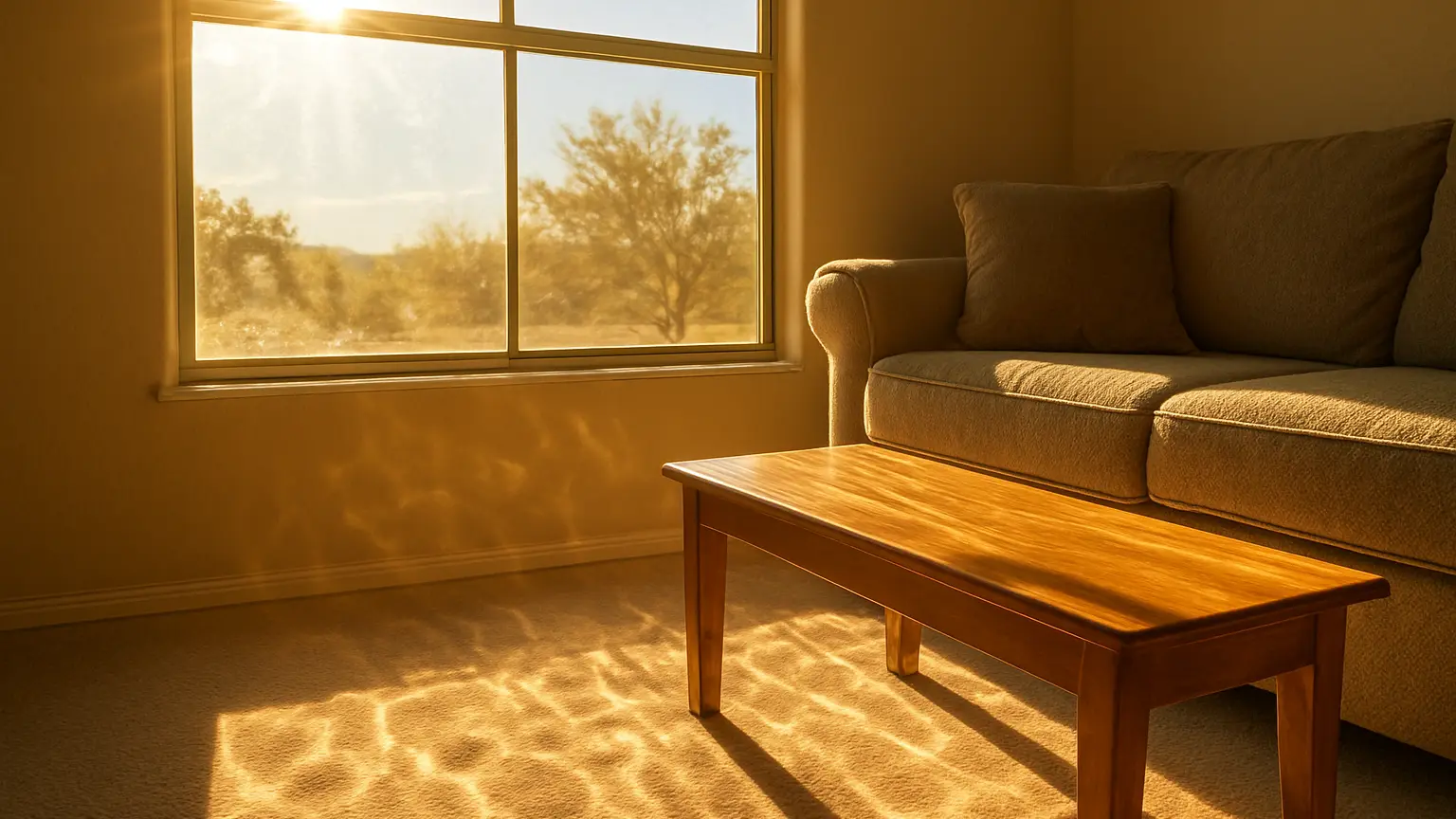
Anyone who has lived through a Mesa summer knows the 4 p.m. problem. The thermostat says 76. The room says otherwise. Your west-facing glass has spent three hours absorbing low-angle desert sun, and now the couch is warm to the touch and the AC has not shut off since lunch.
Shade screens help. Blackout curtains help. But both fixes trade your view for comfort, and neither one stops heat before it hits the glass. The real answer sits in the glass itself. Here are four glazing upgrades worth knowing about, ranked by what they actually do to your cooling bill versus what they cost to install.
Why West-Facing Windows Behave Differently Here
South-facing glass takes sun from above, which means an overhang or a roofline can block a good chunk of it. West glass gets hit almost horizontally between 3 p.m. and sunset. Nothing shades that angle. Worse, it lands during the hottest part of a Mesa afternoon, when outside air is already sitting at 108 and your AC is already working at full tilt.
The number that matters is Solar Heat Gain Coefficient, or SHGC. It runs from 0 to 1 and tells you how much solar energy passes through the glass. Plain single-pane glass sits around 0.80, meaning 80 percent of the sun's heat comes right in. Good desert glazing lands between 0.20 and 0.25. That difference is the entire game.
The second number is U-factor, which measures heat conduction. It matters here too, but less than SHGC. In Phoenix-area homes, radiant solar gain through windows typically accounts for a much larger share of the cooling load than conduction does.
Upgrade One: Low-E Coatings
Low-emissivity coating is a microscopically thin metallic layer applied to the glass surface. It reflects infrared heat while letting visible light pass. You cannot see it. You will feel it.
There are two families worth separating. Hard-coat, or pyrolytic low-E, is baked into the glass during manufacturing. It is durable and cheap but less selective, so it blocks less solar heat. Soft-coat, or sputtered low-E, is applied in a vacuum chamber and must be sealed inside a dual-pane unit. It performs considerably better and is what most Mesa homes should be getting.
What It Costs and What It Returns
- Typical price: $350 to $650 per window installed for a dual-pane low-E replacement in a standard opening
- SHGC range: 0.25 to 0.35 depending on the coating
- Cooling impact: homeowners commonly report a 10 to 18 percent drop in summer cooling costs when replacing single-pane west glass
- Comfort change: immediate and obvious, especially within six feet of the window
Low-E is the baseline. If you are replacing windows in Mesa and low-E is not part of the quote, something is wrong with the quote.
Upgrade Two: Spectrally Selective Glazing
This is where things get interesting for west exposures. Spectrally selective glass is a refined low-E product engineered to split the solar spectrum with unusual precision. It admits most visible light while rejecting the near-infrared band that carries the bulk of the heat.
The practical result is a window with an SHGC around 0.20 that still has a visible light transmittance near 0.50 or higher. You keep a bright room. You lose the oven effect. Compare that to old-school bronze or gray tinted glass, which cut heat by simply making everything dim and murky.
The West-Wall Sweet Spot
For a Mesa home with three or four large west-facing windows or a west slider, spectrally selective glazing is usually the single best dollar-for-degree decision available. The premium over standard low-E is modest, often 10 to 20 percent, and the extra heat rejection lands exactly where your house needs it most.
- Typical price: $450 to $800 per window installed
- SHGC range: 0.18 to 0.25
- Cooling impact: 15 to 25 percent reduction on cooling load attributable to those openings
- Bonus: significantly less fading on flooring, artwork, and upholstery
One thing installers do not always mention: pairing spectrally selective glass with argon gas fill and a warm-edge spacer improves the U-factor without touching the solar performance. Ask for both. The upcharge is small.
Upgrade Three: Smart Tinting Glass
Dynamic glazing changes its tint on demand. There are a few competing technologies. Electrochromic glass darkens when a low-voltage current is applied and holds that state without continuous power. Thermochromic film tints passively as its own temperature rises. Suspended particle devices align microscopic particles to shift from opaque to clear almost instantly.
For a west wall, the appeal is obvious. The glass runs clear all morning, gives you the view, then darkens to an SHGC as low as 0.09 during the afternoon assault. No curtains. No screens. Some systems tie into home automation or respond to a rooftop sensor.
The Honest Math
Smart glass is expensive. Expect $80 to $150 per square foot for the glazing alone, which puts a single decent-sized west window in the $1,500 to $3,500 range once wiring and controls are included. Cooling savings on that opening can reach 30 percent or more, but the payback period on cost alone often stretches past fifteen years for a typical Mesa residence.
Where it makes real sense: a great room with a wall of west glass you refuse to cover, a home office where afternoon glare kills productivity, or a high-end remodel where the automation is part of the appeal. Where it does not: bedrooms, hallways, or any opening a $40 blind already handles.
Upgrade Four: Photovoltaic Windows
Building-integrated photovoltaics have moved from lab curiosity to early commercial reality. Transparent and semi-transparent PV glazing embeds thin-film solar cells or organic photovoltaic layers directly into the glass unit. The window blocks heat and generates electricity at the same time.
Current residential-scale products convert somewhere in the range of 3 to 10 percent of incoming solar energy into power, well below a rooftop panel, but they occupy surface area that was previously doing nothing except letting heat in. A west-facing wall of PV glazing produces its peak output during the exact hours when Arizona utility rates are highest and your AC is drawing the most current.
"West glass is the most underused generating surface on a desert house, and it happens to be the surface causing the biggest cooling penalty," says Marisol Vega, senior applications engineer at a firm specializing in clean energy project development. "You fix a load problem and add a supply source with one assembly."
Where This Stands in 2026
- Typical price: $100 to $200 per square foot, with limited residential product availability
- SHGC range: roughly 0.15 to 0.30 depending on cell density and transparency
- Generation: modest, a few hundred watts across a large west wall
- Realistic use today: commercial curtain wall, new custom construction, pilot projects
For most Mesa homeowners, PV glazing is a two-to-five-year watch item rather than a purchase decision. Prices are dropping and warranties are lengthening. Worth tracking, not worth waiting for if your current glass is cooking you now.
Picking the Right Upgrade for Your House
Start with a walk-around at 4:30 p.m. in July. Touch every west-facing pane. Note which rooms your family avoids. That is your priority list, and it is usually shorter than a whole-house replacement quote suggests.
A practical sequence for most Mesa homes looks like this. Spectrally selective dual-pane glazing on every west and southwest opening. Standard low-E everywhere else. Smart tinting reserved for one or two signature openings where blinds are not acceptable. PV glazing held for a future project.
Also confirm the installer is retrofitting the whole insulated glass unit and not just swapping a single pane into an old frame. A failed seal or a bare aluminum frame will quietly undo a chunk of what you paid for. Frame material, spacer type, and installation quality carry more weight in Mesa's heat than most brochures admit.
The Afternoon Test Your Glass Should Pass
The measure of good desert glazing is simple. On a 110-degree August afternoon, you should be able to stand next to your west window with the sun full on it and feel nothing unusual. No radiant push. No warm floor tile. No AC cycling on the moment the sun clears your neighbor's roofline. Every option covered here moves you closer to that, and the differences come down to how much you want to spend and how much glass you are trying to tame.
Low-E is the entry fee. Spectrally selective glazing is the best value for a west wall in this climate and where most Mesa homeowners should put their money. Smart tinting buys convenience and view retention at a real premium. Photovoltaic windows point toward a future where a west exposure becomes an asset instead of a liability. Choose based on the rooms you have stopped using in the afternoon, and let that guide the budget rather than the other way around.